

Printheads
Print quality usually falls away long before a printhead stops firing altogether. Replacement heads need to match the printer family, the limits that matter in daily production, and the fault signs that show a head is finished and needs replacement after proper cleaning and checks.
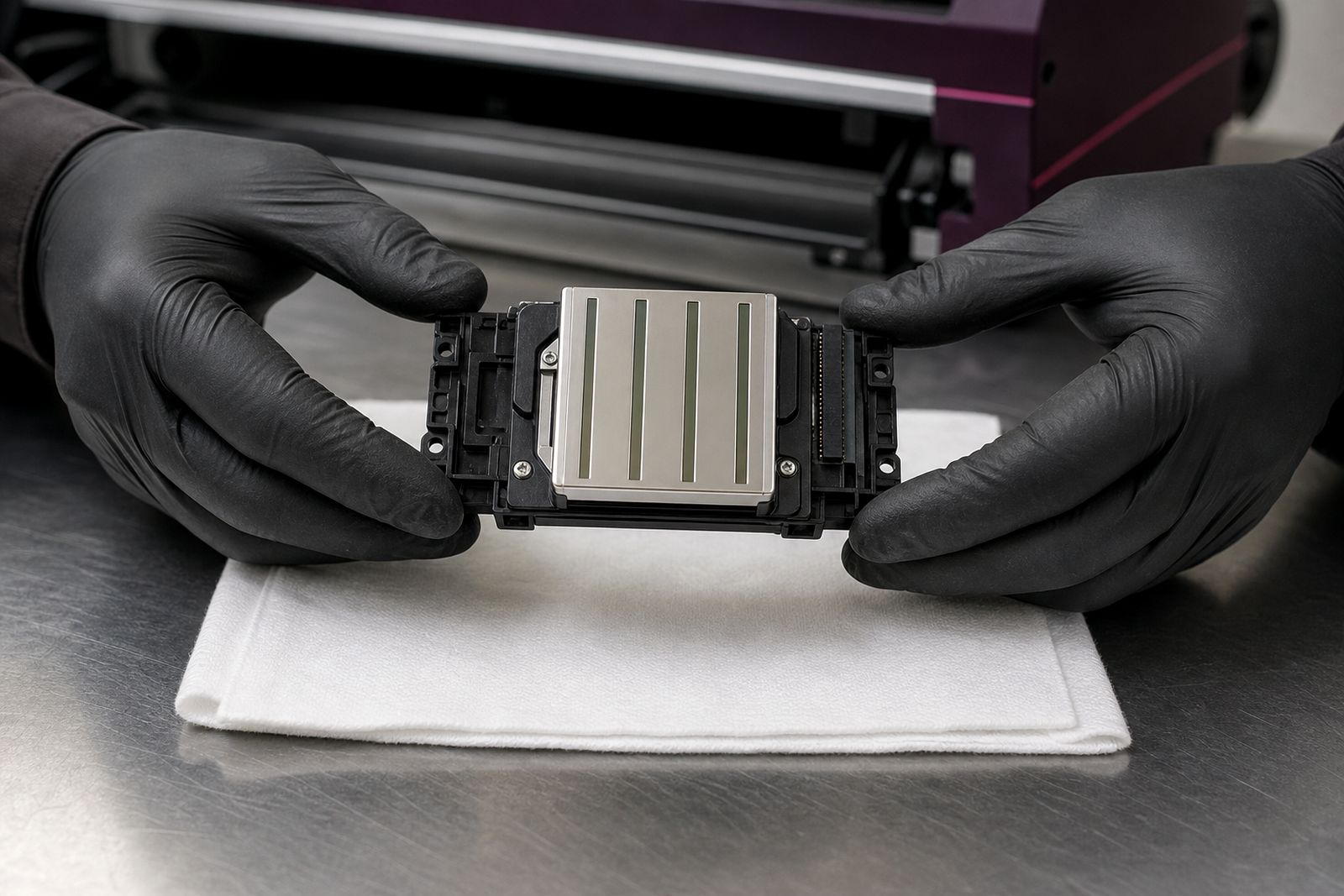
What a printhead does in a wide-format printer
The printhead is the metering part that places ink droplets onto media in a controlled pattern. Nozzle count, droplet range, firing frequency and ink compatibility all affect how a machine handles fine text, solid colour, skin tones, gradients and long production runs. A head that suits a photo lab may be the wrong choice for a sign shop pushing heavy vinyl output all week, and a UV head has very different chemical exposure from an aqueous head.
On most machines the printhead is also one of the most expensive wear items in the ink path. It can fail slowly through nozzle loss, deflection and unstable firing, or fail quickly after a strike, dried ink, air ingress or poor flushing practice. In Highveld conditions dust gets into places it shouldn't, so the surrounding maintenance parts matter almost as much as the head itself.
- Eco-solvent heads are chosen for solvent resistance, stable dot placement and decent run length on sign media.
- Aqueous heads are used where fine photographic output, poster work or proofing need cleaner tonal control.
- UV heads must cope with more aggressive curing conditions and stricter ink handling.
Printer families and the head types they take
We match replacement heads by printer family, carriage layout and ink set rather than by guesswork from a blurry photo. Many wide-format machines look similar from the outside but use different data cables, manifold arrangements, dampers or alignment routines. The safest route is to identify the exact printer model, board version where relevant, and the ink chemistry currently running in the machine.
Some printers run a single head across a narrower carriage. Others run dual or quad head layouts to increase width, colour set or production speed. A head can also be sold in a coded variant with different fluid resistance or electrical characteristics, so the part number on the old unit still matters even when the mechanical fit looks right.
- Single-head systems for lighter production or narrower devices.
- Dual-head and quad-head systems for higher throughput and wider colour configurations.
- Heads supplied for eco-solvent, aqueous or UV chemistry only where the fit is correct.
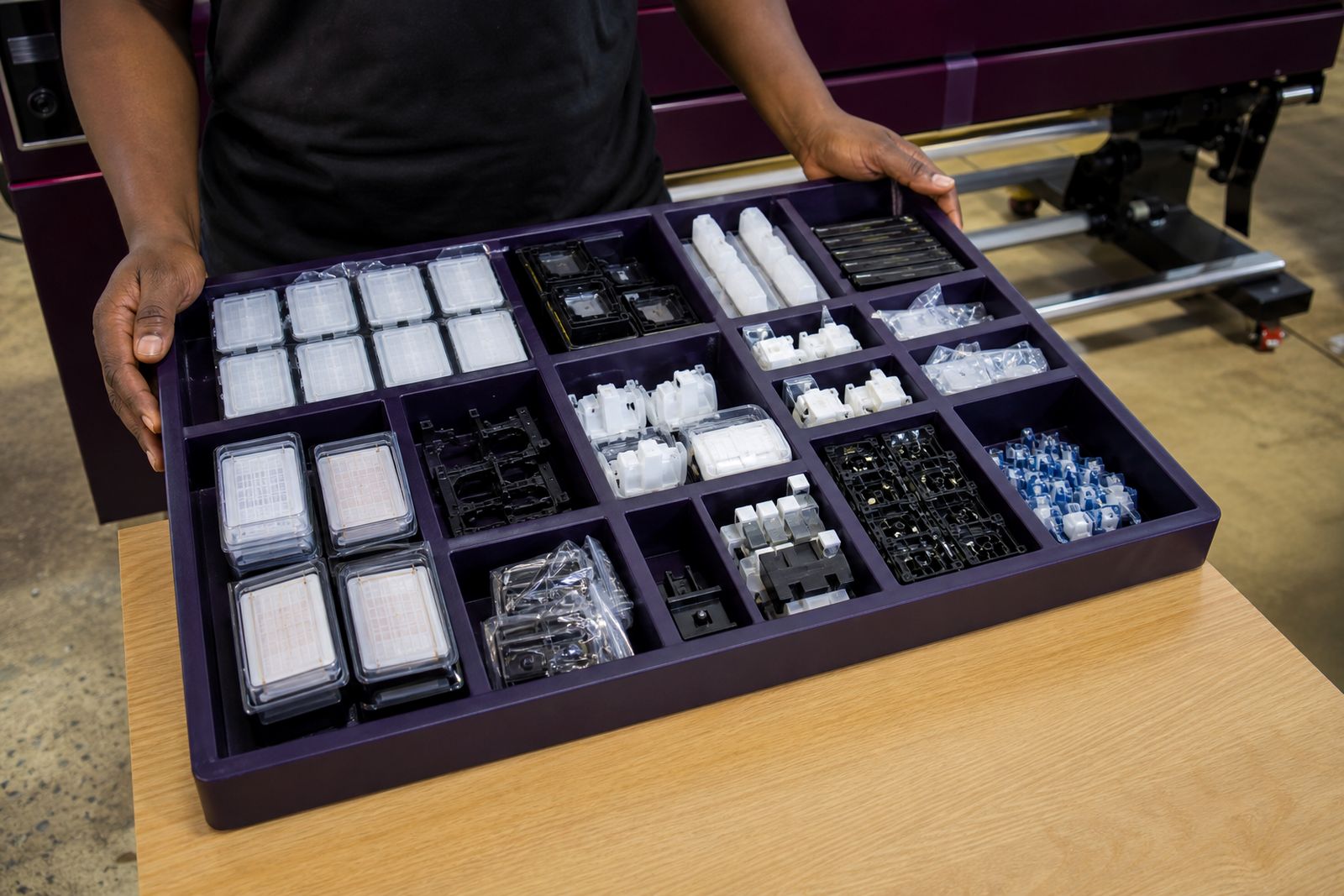
- Related items often needed at the same time, including dampers, cap tops, wipers and data cables.
How to tell a head is really done
A missing nozzle test can come from several causes before the printhead is confirmed as finished. Clogged caps, weak suction, split dampers, contaminated ink, air leaks and dirty encoder strips can all mimic head failure. The useful test is whether the fault moves, clears temporarily after cleaning, returns in the same channels, or shows clear electrical symptoms. Repeating cleans on a dead head usually wastes ink and can push contamination further into the ink path.
Signs that point to a head near the end include persistent nozzle dropout in the same lanes after proper maintenance, heavy deflection on one colour only, random overspray, ink dribbling from the face, repeated electrical errors during head initialisation, or a strike that scores the nozzle plate. UV units can also show cured ink contamination around the face where shielding or maintenance has not been right.
If test prints improve for a short while after a soak or cap clean, the head may still be recoverable. If the pattern collapses again after a few passes, or whole channel groups are dead, replacement is often the cleaner route. That saves media, operator time and the daily frustration of trying to nurse unstable output through customer work.
Working limits that matter before you buy
The printed result depends on more than width and headline speed. Head resolution, droplet size range and firing stability determine whether a machine can handle close-view graphics, backlit panels, canvas, wallpaper or photo paper without banding. A coarser production head can move a lot of ink onto PVC and banner stock, but it may not suit delicate skin tones or tiny text viewed at arm's length. On the other hand a fine-dot photographic head can be wasted on rough outdoor work where speed and laydown matter more.
Duty cycle also matters. A shop that prints short runs with idle periods can use a different head arrangement from a studio running long rolls every day. Ink chemistry sets another hard limit. You cannot safely substitute a head built for one fluid set into another just because the mounting points line up.
- Typical native resolutions on wide-format heads range from 300 dpi to 1200 dpi depending on family.
- Droplet ranges commonly span from small picolitre dots for fine image work to larger drops for stronger laydown.
- Firing frequency and pass count affect productivity, especially on solid fills and billboard work.
- Media type changes the practical result, because porous papers and coated films accept ink very differently.
Fitment, set-up and the parts around the head
Installing a new printhead calls for more than changing the head itself. The carriage needs to be clean, cables seated correctly and ink delivery stable before power-up. Depending on the printer family, the process can include charging ink, setting head rank data, bi-directional alignment, media feed calibration and fresh colour profiling. If a machine has been limping along with poor capping or blocked dampers, fitting a new head without fixing the surrounding parts is asking for trouble.
For Centurion workshops and print rooms across Gauteng the local climate is a factor. Dry winter air, dust from open roller doors and long idle weekends all add stress to the nozzle face. A machine standing near extraction, sunlight or powdery finishing areas often needs closer maintenance intervals. Keeping the capping station healthy and the wiper clean sounds basic but it makes a real difference.
- Check cap tops, pumps and wipers before installing a replacement head.
- Use the correct flush and cleaning routine for the ink type in the machine.
- Run alignment and profiling after fitment where the printer family requires it.
- Record the fault pattern before removal so comparisons are possible after installation.
What to send with your enquiry
The best way to identify the right head is accurate machine information and a few useful photos. A cropped nozzle test, the printer model label, the old head code if visible and a note on current inks usually give enough direction to avoid the wrong part. If the machine reports carriage or head voltage errors say so, because that can point to cable or board issues rather than a printhead alone.
Please include the province for delivery, and mention whether you need only the head or also want related service items packed with it. If your machine is in a photo lab, sign shop or print studio, say what kind of work it handles most often. That helps us judge whether the fault pattern comes from heavy laydown, long idle periods or media contamination. You can send the details through our contact form.
- Exact printer model and, if known, the installed head code.
- Ink type in use: eco-solvent, aqueous or UV.
- Nozzle test photo and a short note on recent cleaning results.
- Any error codes, head strikes or ink starvation history.
- Whether dampers, cap tops, wipers or cables are also required.
What our Wide-format Printing customers say
Verified Google reviews
Questions we get asked
Can a blocked head always be recovered?
Some heads respond to proper flushing and maintenance. Electrical failure, scored nozzle plates and repeated channel loss usually point to replacement.
Do I need to replace other parts with the printhead?
Often yes. Worn cap tops, weak pumps, dirty wipers or split dampers can damage print quality and shorten the life of a new head.
Can one head type be used with any ink if it fits physically?
Ink chemistry, electrical characteristics and printer firmware all need to match the intended head family.
Also worth a look
Tell us about the job
Send sizes, materials and where you are through our contact form, and we will come back with the practical options.
Open the contact form